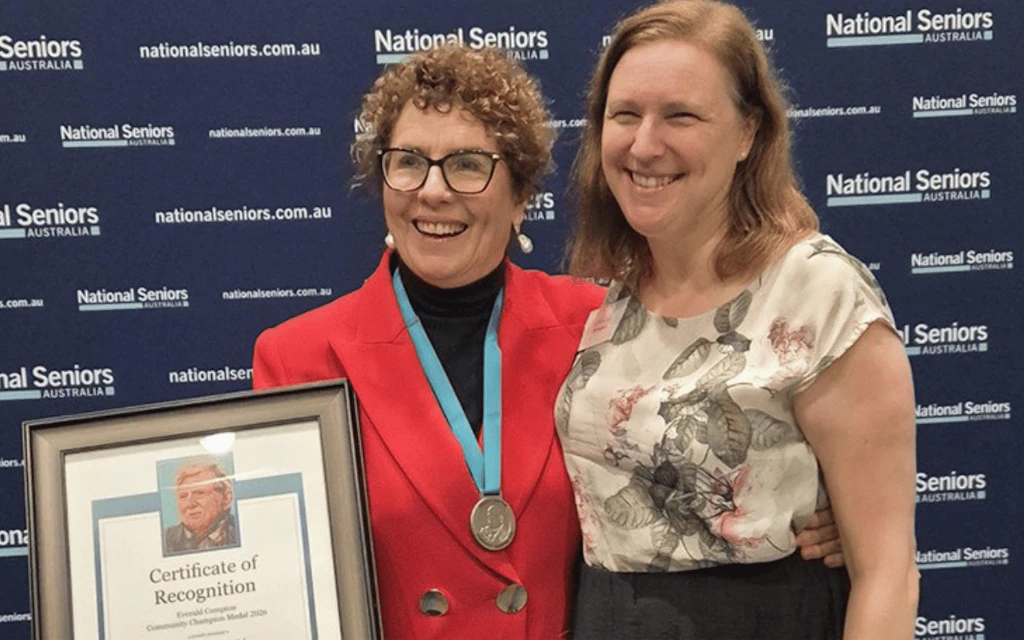
For anyone with high-care dementia needs living at home, the structural reality of the current system is stark: a maximum home care package has 20 funded hours, but what happens during the remaining 148 hours every week? Rosie Fitzgerald can tell you because she lived it.
She was recently awarded the 2026 Everald Compton Community Champion Medal for her community based work supporting seniors to age in place in Kilkivan, a regional town in Queensland. But that’s on the back of caring for her neighbour, Hayden, for eight years who had dementia but lived alone.
Her experience highlights an uncomfortable question: who is absorbing those 148 hours, and what happens when they can’t?
What Support at Home doesn’t fix
On November 1 2025, Support at Home began and was positioned as ‘reform’. But for regional recipients, provider administration and management fees are eroding the actual hours of care delivered. The math gets worse, not better.
“Support at home is, on the ground, offering less support than we imagined it was going to,” she says. “Because of the outrageous charges that providers are able to exploit people with.” This gap – between higher fees and less support – isn’t a provider specific problem: it’s a structural design one. It wasn’t closed by the policy change and aged care leaders need to understand that.
Plugging the gap in regional Australia
When no government infrastructure exists to support dementia carers, Kilkivan District Community Care Association Incorporated (KDCCAI) built its own – in partnership with the University of the Sunshine Coast, on grant funding, with no confirmed continuation.
Rosie is the current President of the non-profit that ran a series of 10 workshops with community members, co-designed with Associate Professor Sophie Andrews at the University of the Sunshine Coast (UniSC). Topics included nutrition, social support, and available online resources, featuring guest speakers, like a dietician from the Thompson Institute at UniSC.
“There’s just nothing in this area to support [carers of people with dementia].,” Rosie laments. “Sophie [at the University of Sunshine Coast] had overseen the co-design with community members last year, and then the 10 workshops were rolled out over a number of months, and they were just fantastic.”
While the workshops were well-received by participants, this isn’t exactly a success story. What it does offer is evidence that the informal carer workforce – the people bridging the 148-hour gap – is under-supported enough that a community organisation had to build its own intervention from scratch.
The assumption putting pressure on regional communities
Providers making care planning decisions – particularly in regional settings – are often working with an implicit assumption that informal carers will bridge the gap. This assumption is unwritten, uncosted, and unmanaged.
What happens when an informal carer can’t continue? When a volunteer burns out? When a family member moves for work? In Rosie’s own case, she cared for her neighbour for eight years. That’s not sustainable for everyone nor a replicable system.
Leaders, does your care planning process name the 148 hours? And if not, what are you actually signing off on? While it’s not your responsibility to manage a client’s entire life, keeping assumptions in check is duty of care – because what happens in those 148 hours directly impacts your team on the ground.
This is a sector-wide issue, not a blame game
Rosie’s experience and subsequent community work highlights what IS possible. The responsibility shouldn’t be sitting solely on a community’s shoulders, but shared across the entire sector.
Providers need to audit how often informal carer availability is a de facto condition of their care plans. Where it is, that’s a risk that isn’t being managed – and one that leaves both residents and support workers vulnerable, which is the antithesis of the work at hand. And what’s happening in Kilkivan is one indicator of what community-led evidence building looks like – and the funding precarity that makes it unsustainable as a sector strategy.
Support at Home was designed to help people to age in place, at home. But for people with high dementia care needs in regional Australia, the system is not yet delivering that. The gap in service delivery in regional Australia isn’t an anomaly and it won’t improve if leaders stay quiet. The opportunity here needs to move from ‘best laid plans’ to real action – the good news for the sector is that there’s plenty of champions on the ground, like Rosie, ready and willing to roll up their sleeves.


