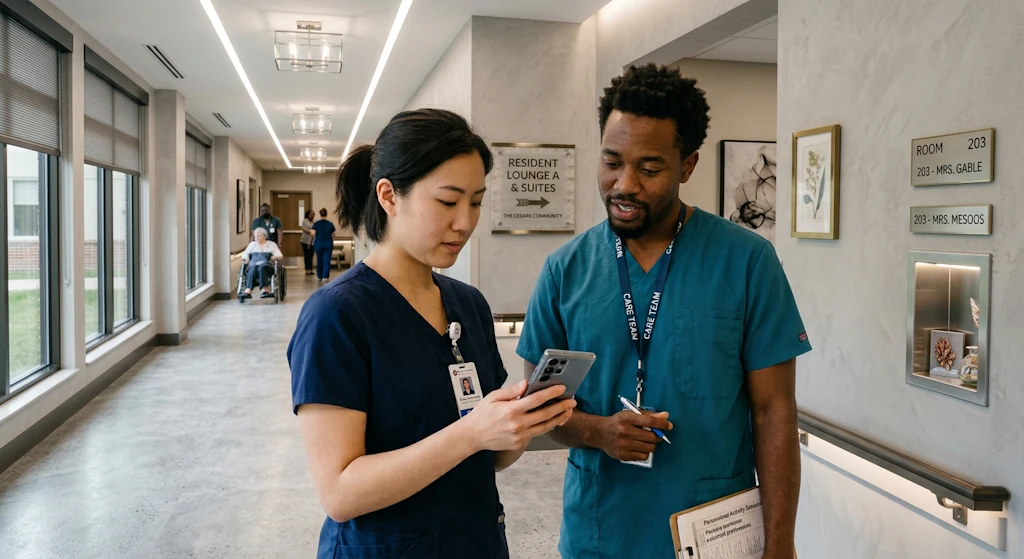
When organisations talk about technology in aged care, the conversation often starts with software. It should start with people.
The Royal Commission challenged the sector to improve the quality of care and today’s mandatory benchmark of 215 minutes of direct care per resident each day, including 44 minutes from a registered nurse, reflects that commitment.
Yet meeting those expectations remains difficult
The Productivity Commission reports that fewer than half of residential aged care services met both their total care minutes and registered nurse care minute targets during 2024-25. But a staffing benchmark can only describe the amount of care required; it can’t create the workforce needed to deliver it.
With the sector facing a projected shortage of 17,551 full-time-equivalent nurses by 2035, the challenge is increasingly about how scarce clinical capacity is used, not simply how many minutes are rostered.
For leaders, the challenge is not simply about meeting a number
It’s about creating the conditions where care teams can consistently provide the right support to residents without being weighed down by unnecessary processes.
A ratio or care-minute target is an important baseline, but it doesn’t account for the reality of every shift, including:
- Changing resident needs
- Unplanned absences
- Different levels of acuity, and
- The practical challenge of having the right skills in the right place at the right time.
Every organisation has friction points: a nurse waiting for information before responding to a resident’s need; a care worker walking across a facility to locate a colleague; or a team spending time piecing together information that should already be available.
Individually, these moments may seem small. Across an entire workforce, every day, they add up. This is why the debate about staffing cannot stop at headcount. When the workforce is under pressure, the way people are deployed and supported becomes just as important as the number of people on the roster.

The impact is felt beyond efficiency
Time spent navigating systems is time not spent building relationships with residents, understanding changes in their condition or providing reassurance to families.
“The conversation around technology often focuses on what a system can do,” says Jessica Poy, General Manager – Aged Care, Rauland Australia and New Zealand. “The more important question is whether it helps people do their jobs with less friction. If a technology adds another step to an already busy workflow, it has missed the point.”
This distinction matters because aged care is not a sector where technology can simply be introduced and left alone. Care environments are complex, resident needs change, and. workflows evolve. Staff respond differently depending on the circumstances of each shift.
The role of technology is not to standardise care or replace professional judgement: it’s to support the decisions people make every day by improving access to information, strengthening communication and helping teams understand where improvements can be made.
Technology can’t solve a workforce shortage, and it shouldn’t be presented as a substitute for people. Its value is in helping organisations make better use of the people they have by reducing avoidable work, delays and communication gaps.
In aged care, visibility is an important part of that equation
Decisions about workforce planning, processes and quality improvement are stronger when they’re based on evidence, rather than assumptions or isolated experiences.
Real-time information helps teams respond to what is happening in front of them. Historical data provides another perspective: revealing patterns over time that may otherwise remain hidden. Trends in communication, response times and workflow activity can help organisations identify opportunities to refine processes, allocate resources more effectively and address issues before they become embedded.
“We often find that the challenge leaders are trying to solve is not always the challenge they first identify,” added Jessica Poy. “Data helps teams look beyond the symptoms and understand what is actually happening within their workflows.”
That shift – from reacting to problems to understanding why they occur – is where technology can make a meaningful difference.
The most effective technology is rarely the technology people notice
It works quietly in the background, supporting communication, reducing unnecessary administration and giving teams more confidence in the decisions they make.
This is the principle behind solutions such as Rauland Concentric Care Unify. Rather than replacing the human connection at the centre of aged care, it’s designed to support it by helping teams communicate more effectively and use operational insights to continuously improve the way care is delivered.
The future of aged care won’t be shaped by technology alone, but by how well technology supports the people who provide care.
Because better systems can’t create better care on their own. Better care happens when capable people have the time, information and support to do what they do best.


