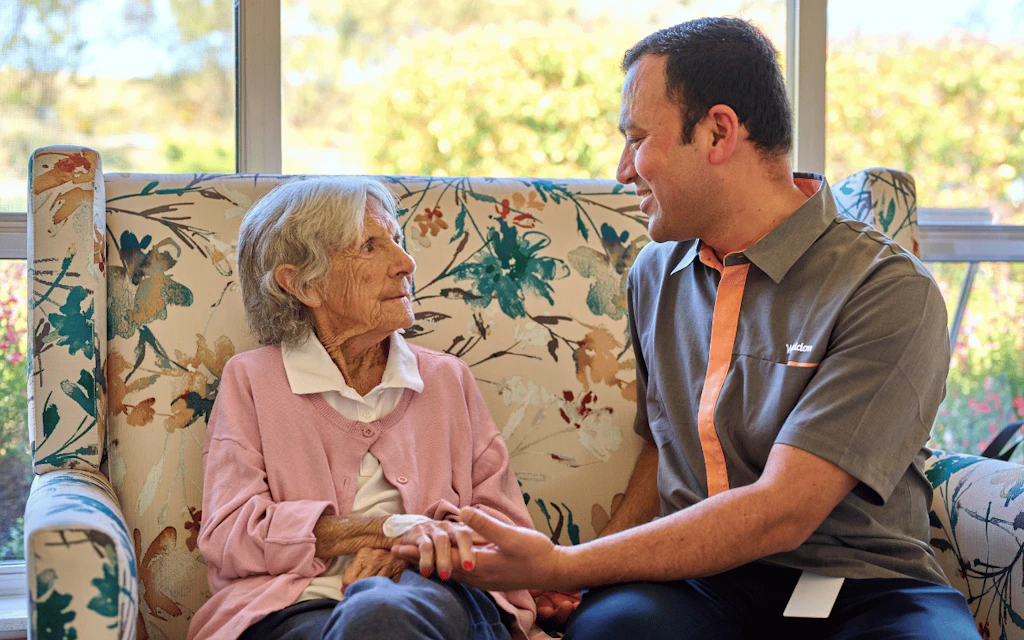
This year’s Dementia Action Week says ‘it’s time to talk about Dementia’ – and one aged care provider is embodying the call.
One of their residents wouldn’t let anyone get close. Staff at one of Whiddon’s memory support homes knew the pattern well. If they approached, she pushed them away. If they offered help with showering, the day could turn into a standoff.
Then a care worker trained in Whiddon’s new RBC Enrich program started sitting with her. There was no agenda and no task – she started by giving her time.
“Very quickly, this lady started to open up,” says Karn Nelson, Executive General Manager, Research & Positive Ageing at Whiddon. “She was more sociable. She was taking part in activities. She was assisting staff with her personal care. Nobody could quite believe that. And now she’s walking around hugging people.”
In the same home, a man who was almost always asleep and rarely spoke to anyone was paired with a carer. She began sitting with him and holding his hand, even while he slept. When he woke, she listened.
“He is now awake all the time,” she laughs, “engaging in conversations.” He also raised something that had clearly been on his mind. He wanted to talk about whether he was afraid of dying.
Nelson is careful about how these stories are told. “They sound subtle, but they’re not subtle. They’re big changes.”
The gap relationship-based care couldn’t close
These are two of a handful of stories coming out of RBC Enrich, a pilot Whiddon is running at their Easton Park – Taylor House and Maclean care homes in partnership with US-based organisation Memory Bridge. It’s an extension of the relationship-based care (RBC) approach Whiddon has been embedding for about a decade.
That approach worked across most of their services, but less so in their memory support homes.
“There was a missing piece of the puzzle,” Nelson says. “How do you really meet the emotional needs of people who may no longer be able to communicate in traditional ways?”
Nelson says most daily contact with residents living with moderate to advanced dementia is transactional: personal care, meals and comfort check-ins. Staff can deliver it in a person-centred way, but it rarely builds a relationship.
“You have all sorts of other needs being met, but not the emotional,” she says.
What the program asks of staff
Under RBC Enrich, each resident has one or two consistent staff buddies who spend structured one-on-one time with them each day. Staff are trained to be present and let the resident lead – a less familiar approach for care workers who often have a strong instinct to ‘fix’.
“We’re all fixers,” Nelson says. “Would you like some orange juice? Are you too hot? Are you too cold? All of those things have to go to one side.”
Staff use gentle curiosity to help residents express what they feel, whether that’s grief, frustration or joy. Nelson is clear that carers aren’t acting as therapists: the aim is understanding. That moves practice away from behaviour management and towards asking why a person is distressed.
To create the right environment for this program to take hold, coaching sits on top of the training staff receive. Then, a community of practice will also link coaches and buddies across Whiddon’s pilot sites.
Nelson says many staff already do some of the RBC approaches instinctively. Yet what they lack is confidence, or a sense that they’re allowed to.
“We’re saying yes, you absolutely do have permission,” she says. “In fact, we expect you to do this as part of your practice.”
The operational problem underneath
Carving out daily one-on-one time is the hardest part. Nelson points to growing compliance demands and the unintended consequences of care minutes. Staff are spending more time on documentation and less on care that isn’t task-based. That’s why the pilot is testing sustainability as closely as outcomes.
“What do we need to change to incorporate this as daily practice?” she says. “You’ve got to trial it. You’ve got to see what works and what doesn’t.”
Her advice to other providers is direct: start with culture. “You have to have a belief in relational care,” she says. “If you don’t have that within your culture, that’s your first thing.”
Then, look hard at systems, environments and staff support. “You can’t just add something like this on,” she says. “You’ve really got to support it, otherwise it will fail.”
A shift in how staff see residents
The earliest feedback came from the clinical nurse coordinator at the first pilot home. According to Nelson, she said staff quickly began to see residents as people with feelings like their own. They came to work and talked about residents that way, and about why they might be acting in certain ways.
Nelson says staff are also taking the skills home, using them with their children and older relatives.
For her, at the core of RBC Enrich is a belief that emotional connection belongs with the basics.
“We all need food, we all need water, but we also all need emotional support,” she says. “If you take away one of those, you can’t really function.”


