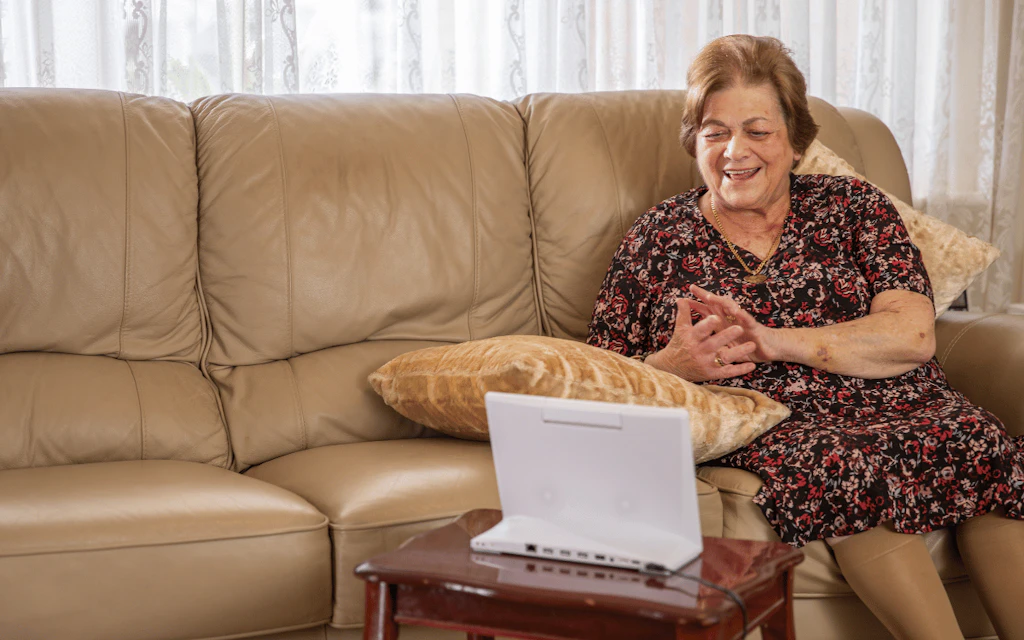
Technology is becoming an increasingly important part of aged care, from helping residents stay connected with family to making everyday tasks a little easier.
For Zac Bailey, the problem with his father’s phone wasn’t the phone itself. It was everything his father had to do to use it.
After his second-to-last stroke-like episode, Bailey’s father moved into aged care in his mid-60s because he could no longer walk. He could still use a Samsung tablet for word-search games, but fine motor control, sequencing difficulties, low impulse control and verbal aphasia made everyday technology difficult to manage.
“Most smartphones require about six individual steps to make a call,” Bailey says. “That’s way too many for someone who struggles to sequence.”
Bailey used to visit his father every night. When COVID stopped those visits, he realised how difficult it could be for families to stay connected when a resident couldn’t operate their phone.
His father might not answer, forget to charge it, hold it the wrong way, or accidentally turn on mute or switch off the speakerphone. The care team would sometimes lend him a mobile, but someone needed to stand beside him to help.
“I’m an engineer by trade, and I’d already imagined what a solution could look like, a dementia clock with a camera and speakers on it, and I went looking for it. I was surprised it didn’t exist.”
So, Bailey created one.
Assistive technology needs to solve the right problem
Bailey says technology designed for older people often focuses on eyesight.
“They just assume it’s about eyesight, so they make the buttons bigger.”
But bigger buttons don’t help if the problem is remembering which buttons to press.
“It’s about having no menus; every action needs to be at most 1-touch and also controls which help for low impulse control.”
Mobility can create another barrier, too. A resident may not be able to reach their phone at all, making features such as automatic answering useful.
Bailey also challenges the idea that older people are resistant to technology.
Every older person has learned more new technology in their life, and lived through more changes, than the younger people who designed that technology.
His father had been an engineer and had used plenty of technology throughout his life. His ability to use it had changed.
“It’s not a learning gap, it’s about taking on the challenge of designing solutions for everyone, no matter how hard the design challenge may be.”

Innovation doesn’t always mean high-tech
CareWindow is one example of aged care assistive technology designed around a specific problem. Other solutions are much simpler.
At Orana Aged Care in Kingaroy, Queensland, staff use a 3D printer to make personalised aids including pen holders, paintbrush grips, bottle holders and bingo tools. Some cost as little as 30 cents to make.
For one resident, a 3D-printed aid meant she could play bingo again. Another uses a wheelchair-mounted holder to keep her drink bottle within reach.
At the other end of the scale, Allity has been trialling Abi, a conversational robot developed by Andromeda Robotics, to interact with residents and support engagement.
A robot and a 30-cent bingo aid are very different solutions. But both started with a person and a problem.
Start with the resident
For aged care providers, Bailey believes that’s where the process should begin. Rather than starting with a list of products, look at what’s happening day to day:
- Is a resident struggling to use their call device?
- Is there something staff have to do for someone every day that the resident could potentially do themselves?
- Has someone stopped taking part in an activity because they can no longer manage one part of it?
Bailey also wants providers to become more comfortable with pilots.
“In reality, their workers are smart, and they need to be ready to run pilots more frequently.”
Safety, privacy and liability still need to be considered, but Bailey says concerns about technology being damaged or misused shouldn’t automatically prevent residents from accessing it.
“They prioritise aspects like ‘avoiding the tech being broken by mistake’ and ‘making sure it isn’t being used to record activity’ over the resident’s right to autonomy and to be in contact with their loved ones.”
“The aged care provider has the privilege of working in the resident’s shared house.”

Where to next?
Bailey sees opportunities for assistive technology in aged care across communication, telehealth, entertainment, community engagement and injury risk reduction for workers.
It’s not about greeter robots; it’s about helping the workers do their job more safely.
He also sees potential in retrofitting older facilities and retirement living communities, as well as using technology to help people stay at home for longer.
His father moved into care because his mother could no longer lift him. “An at-home robot would have changed that.”
For providers considering aged care innovation, Bailey’s advice is to start with the person, not the product.
What is making life harder for this person, and could technology make it easier?


