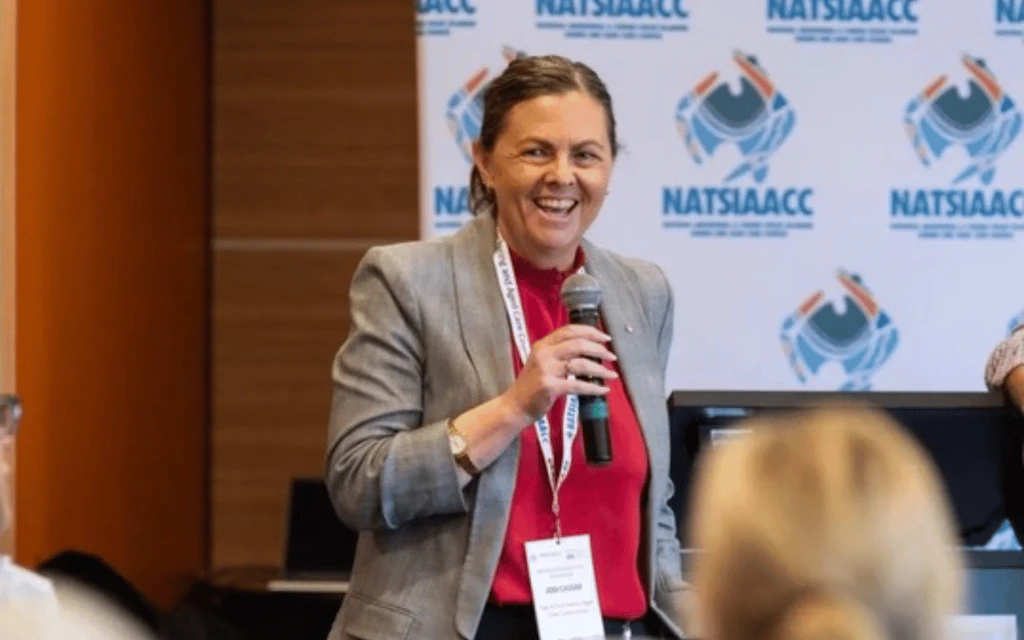
Some leaders arrive on the scene, vision decks and soapboxes at the ready. Transformation and innovation are the order of the day and origin stories may drift off into the background, forgotten.
Jodi Cassar arrives as the Interim First Nations Aged Care Commissioner with an approach that is far more practical, and transformative at its core.
Cassar speaks less about the power of policy change than helping the government listen better. After spending a short time speaking with her, it’s clear where her priorities lie.
Ask about her career achievements and she talks about communities that she’s worked with. Ask what success looks like and she talks about elevating Elders’ voices. Ask about the office she’s building and she talks about the permanent Commissioner who will one day inherit it.
Introducing Interim First Nations Aged Care Commissioner, Jodi Cassar
For someone tasked with establishing one of the most significant new offices in Australian aged care, Cassar is both humble and direct.
While still early at the helm, Cassar brings more than two decades of public service experience across human services, disability reform and social policy. The portfolios may have changed, the thread running through her career has not.
“The journey for me so far has always really been about the people that we serve,” she says. Behind every policy, program and reform are “real people and… families and communities.”
When lived and professional experience come together for change
It is an outlook shaped as much by lived experience as professional experience. Cassar speaks openly about her 96-year-old grandfather and her mother’s advanced dementia, and the challenges her own family faces navigating aged care. Her work is not abstract; like many Australians, Cassar understands that the policies developed in Canberra inescapably find their way into somebody’s living room.
Rather than crediting consultation as an end point, she sees it as the beginning of an important relationship. Listening, she says, must be followed by action and by “closing the loop”, ensuring communities understand what happens with the stories they’ve shared.
It is an idea that extends beyond the First Nations Aged Care Commissioner’s office and into aged care itself.
For years, the sector has championed person-centred care, yet many providers still expect people to adapt to established processes, assessment pathways and service models.
Cassar says, “services need to be prepared to adapt the way that they work rather than expecting people to adapt to the system.”
Culturally safe care and ACCHO aged care partnerships
Although she is specifically speaking about ‘culturally safe’ care for Aboriginal and Torres Strait Islander people, the principle has broader implications. It challenges providers to see cultural safety not as a training module or compliance exercise, but as an organisational capability grounded in relationships, trust and responsiveness to the individual experience.
Cassar is also clear that mainstream providers don’t have to build this capability alone.
Practical cultural safety, she says, includes “partnering with Aboriginal community controlled organisations”, involving families and communities in care discussions, and understanding the cultural protocols that shape how care is experienced locally.
It is a subtle but significant shift.
Rather than asking Aboriginal and Torres Strait Islander people to navigate existing systems, providers are encouraged to work alongside the organisations and communities that already hold trust, knowledge and cultural authority. Culturally safe care demands person-centred care in its most authentic form.
Elevating community voices is only part of the success story
This mindset also shapes how Cassar defines success during her term. Not through legislation passed or offices established, but whether communities themselves recognise that something has changed.
“The real success,” she says, “is when communities are actually telling us that they can see the difference and that they can see that their voices are helping to shape decisions.”
When asked about being a woman in a senior public service role, Cassar resists turning the conversation into a personal narrative. Instead, she notes that the public service has traditionally achieved strong representation of women in leadership, particularly across human services portfolios, and simply describes it as a positive outcome.
That understated approach seems entirely fitting for the role she now occupies. The Interim Commissioner is not there to become the public face of reform. Cassar is there to build an institution that will outlast her, creating enduring pathways between First Nations communities and the systems designed to serve them, where, historically, those connections have too often broken down.
First Nations aged care reform: administrative in task, deeply human in purpose
Cassar’s success will not be measured by the profile of the office she builds, but by something far more meaningful: older Aboriginal and Torres Strait Islander people finding it easier to access care that feels safe, respectful and shaped around their lives rather than the system’s convenience.


