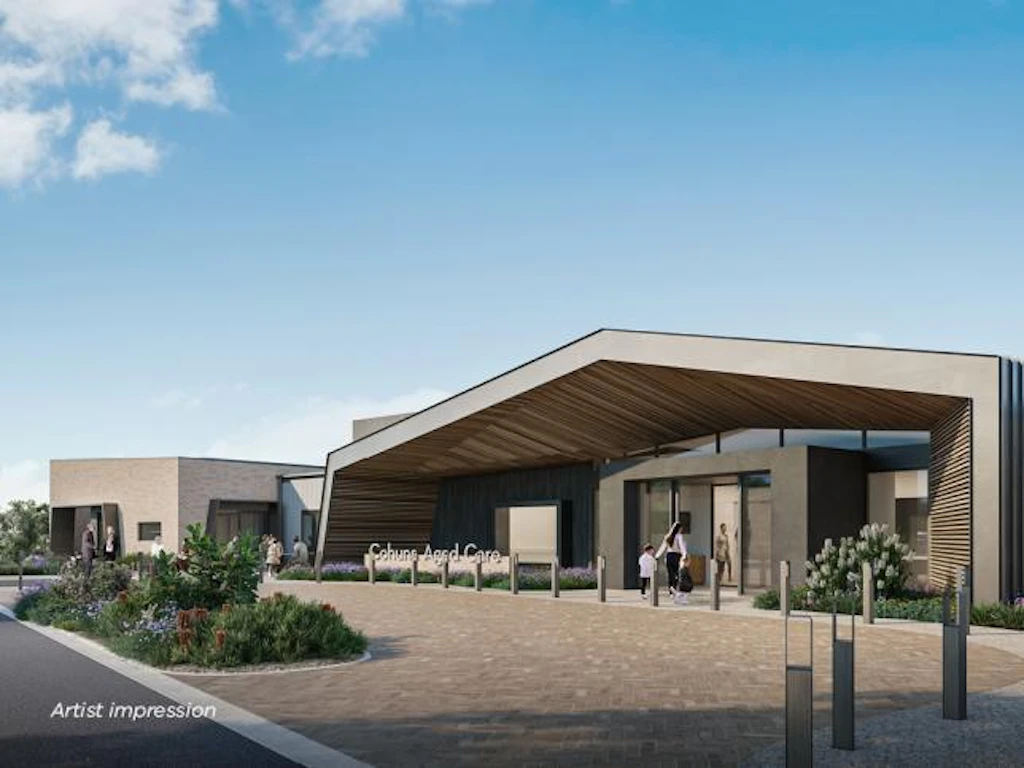
A new publicly funded aged care home has opened in regional Cohuna, offering a glimpse into how governments are starting to rethink care delivery outside metropolitan centres.
Backed by a $41.1 million investment from the Victorian Government, the purpose-built facility brings together residential aged care and acute health services on a single site. The first residents are now moving in.
At a time when access, workforce and hospital pressure continue to collide, the model is doing something deceptively simple. It is putting care closer to where people already live.
Small scale, but more integrated
The 24-bed facility combines 16 residential aged care places with eight acute hospital beds. That co-location matters more than the numbers suggest.
For regional communities, where hospital access can be limited and transfers disruptive, having acute care embedded within an aged care setting reduces the need to move residents between services. It also creates a more flexible response when care needs escalate.
Inside, the design leans into smaller, household-style living. Residents are grouped into shared spaces with kitchens, dining and lounge areas, reflecting a broader shift away from institutional layouts toward more domestic environments.
It is a model that aligns with where policy has been heading for years. Less about scale, more about experience and continuity.
A regional workforce and infrastructure play
More than 540 workers were involved in delivering the project, providing a temporary but meaningful boost to the local economy. Now the focus shifts to what happens next.
The former Cohuna District Nursing Home is being repurposed into administrative space and staff accommodation for Cohuna District Hospital. That decision is not incidental.
Workforce remains one of the biggest constraints in regional aged care. Providing accommodation on site is a practical move that acknowledges the reality of attracting and retaining staff outside major cities.
Public provision still has a role to play
Victoria remains the largest public provider of residential aged care in the country, a position the government has continued to reinforce through targeted capital investment.
For a sector increasingly dominated by private and not-for-profit providers, this kind of development raises a broader question. Not whether public provision should expand dramatically, but where it can play a stabilising role.
In smaller communities, where scale is limited and margins are tight, public investment often fills gaps the market will not.
Ageing close to home is more than a slogan
The language around ageing “close to family and community” shows up in almost every announcement like this. It risks becoming background noise.
But in places like Cohuna, it is not abstract. Moving hours away from home for care is still a lived reality for many older Australians.
Projects like this do not solve the system’s structural challenges. They do, however, show what a more localised, integrated approach can look like when funding, infrastructure and intent line up.
And for regional providers watching closely, the message is clear. The future of aged care is not just about building more beds. It is about building the right kind of care, in the right place, with services that actually connect.


