Trust in Australia is technically rising. According to the 2026 Edelman Trust Barometer, institutional trust climbed five points year-on-year, lifting the country from a position of distrust to neutral. But the headline number obscures a more complex picture.
Trust is rising unevenly
Driven largely by younger Australians and men, while low-income earners have seen little improvement. The gap between high- and low-income earners is now 19 percentage points: the largest since the pandemic. And nearly three in four Australians now hold what Edelman calls an “insular mindset,” meaning they are hesitant to trust those who see the world differently, come from different backgrounds, or hold different values.
It hasn’t totally disappeared in aged care: it’s being consolidated
Pulling inward, toward the familiar and the local, and away from systems and institutions. For aged care leaders, this shift carries an unmistakable message: the space where trust lives has changed. And the sector needs to understand exactly where that space now is.
The good news? Aged care is, at its core, a local and relational industry. The conditions for building trust are already baked into the work. But the conditions for breaking it – complex systems, inconsistent information, opaque pricing, regulatory overload – are also present, and more consequential than ever.
Relationships can make or break trust
“It is a personal, relationship job,” says Adrian Morgan, General Manager of Flexicare, a Brisbane-based community care organisation. “There are tasks to be done, but first and foremost, it’s a relationship job. If you had to have one key performance indicator, it really should be that the client is smiling when you leave.”
Morgan’s view isn’t sentimental, it’s strategic. Trust, he argues, is earned incrementally and lost quickly, built through consistency, genuine care, and the willingness to acknowledge when things go wrong.
“You don’t build it by a single action,” he says. “It’s many things over time. You can’t demand it. You’ve got to earn it.”
That view is echoed at scale by Luke Greive, CEO of Infin8Care, which operates 19 residential homes and cares for more than 2,000 residents. For Greive, the mechanism of trust is located not in brand or reputation, but in the moment of human contact – what his organisation calls ‘moments that matter.’
“The brand isn’t necessarily what they’re trusting,” he explains. “They’re trusting the relationship with the individual that they have. If you change that individual, trust is eroded fairly quickly.”
Who Australians trust is changing
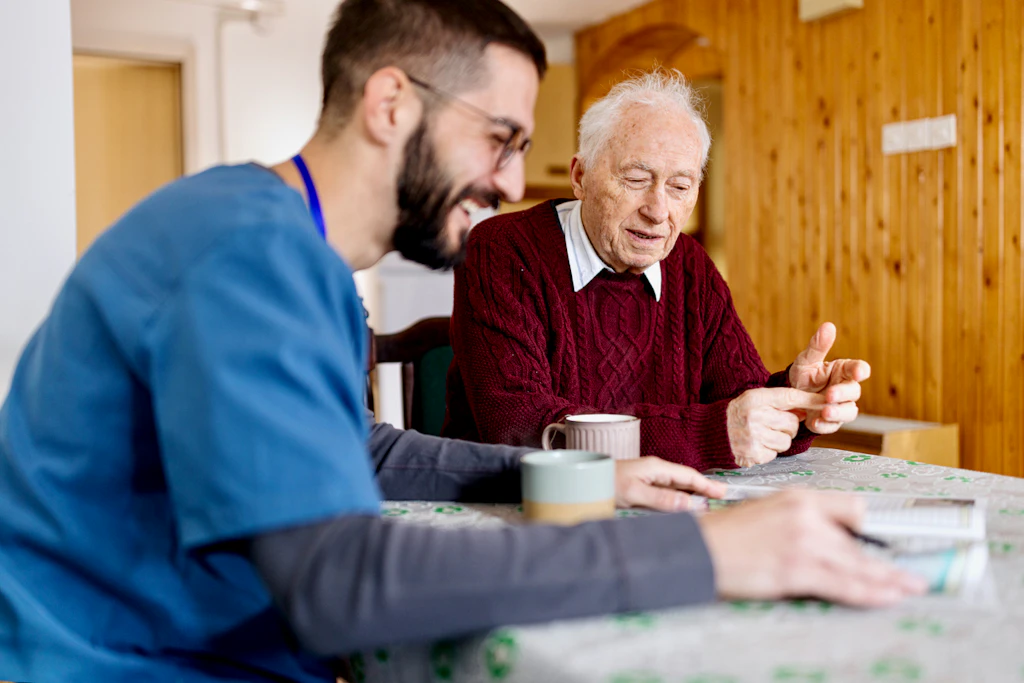
Greive’s observation maps almost exactly onto the Edelman data. People are not retreating from trust altogether, but are directing it toward what feels knowable and dependable: the care worker who remembers how much Vegemite goes on their toast; the nurse who shows up consistently; the support worker who brings a surprise gift to their 90th birthday. These are the acts that build durable trust, and they are the acts that aged care – uniquely among industries – is positioned to deliver.
But structural conditions of the sector often work against this
Both Morgan and Greive point to the same fault line: a system that asks frontline staff to be the human face of trust while simultaneously placing them in impossible positions. When government information conflicts with provider guidance – as what can happen with Support at Home co-contribution rates – clients receive conflicting messages from sources they should each be able to rely on.
“They feel they should be able to trust the government organisation giving them this information,” Morgan says, “and then we’re saying something different.” And the result is not just confusion: it’s a loss of trust in both parties, and a fraying of the relationship that care workers have painstakingly built.
Greive is equally direct about the regulatory burden. Documentation requirements, revised resident agreements, the complexity of aged care financial assessments – each one is reasonable in isolation, but collectively they position providers as bureaucratic intermediaries rather than trusted carers.
“A lot of the infrastructure and requirements in terms of reporting,” he says, “actually breaks trust, because the provider has to explain things to residents and their families, and none of it makes a great deal of sense.”
Income inequality also adds another layer of complexity
The Edelman findings on income inequality add another layer of urgency. With a 19-point trust gap between high- and low-income earners, and with less than a quarter of Australians believing the next generation will be better off, there’s a real risk of a two-speed aged care experience where those with more resources have access to richer services… while others feel the pinch or miss out.
Greive raises it directly: “We don’t want to get into a system of haves and have-nots.”
Pricing transparency, perceived fairness, and the clarity with which providers communicate what residents are entitled to and why are no longer just operational concerns. They are trust issues.
So what can aged care leaders do to continue to build trust?
The answer isn’t to rage against the system because many of the constraints lie outside a provider’s control. But this is a call to be honest about them and design for trust in the spaces they can control. What does that look like?
Morgan and Greive suggest that means rostering for consistency. It means training staff not just in what to do, but how to do it and why. It’s also ensuring families receive clear, timely, accurate information in the critical early weeks of a care relationship, when trust is most fragile and the stakes are highest.
And it means acknowledging, as Morgan does, that the initial interaction is “really vital,” and that when things do go wrong, the fastest path back to trust is to say so and put it right.
In a country where insularity is rising and institutions are viewed with increasing scepticism, the competitive advantage for aged care providers is not scale, brand, or technology. It’s the quality of the human relationship: consistent, local, and known. The Edelman data hasn’t created that truth, however, it’s just made it harder to ignore.


