Tim Lawless says Australia’s ageing population is creating unprecedented demand for retirement living – but delivering enough homes may be the sector’s greatest challenge.
Australia’s population is ageing, older Australians are becoming wealthier, and demand for retirement living continues to grow.
Yet according to Tim Lawless, Executive Research Director at Cotality, the sector’s biggest challenge over the coming decades may not be attracting residents – it may be delivering enough homes to meet demand.
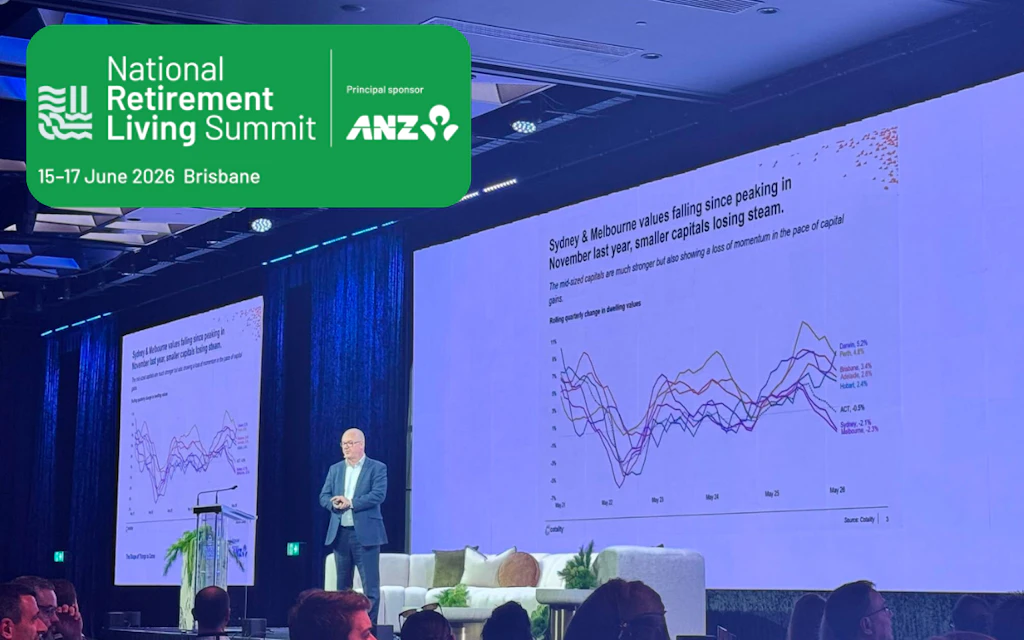
Opening the National Retirement Living Summit 2026 in Brisbane, Lawless painted a picture of a sector underpinned by powerful demographic tailwinds, but facing increasing pressure from housing affordability constraints, construction challenges and slowing residential market conditions.
“The silver tsunami, as they call it, is already underway and gathering some momentum,” he told delegates.
His message was clear: the long-term demand outlook for retirement living remains compelling, but supply-side barriers are becoming increasingly difficult to ignore.

Housing remains the key to retirement wealth
Lawless began by examining Australia’s housing market, noting that while property values remain elevated, momentum has slowed significantly since peaking in late 2024.
Sydney and Melbourne have moved into decline, while stronger-performing markets such as Brisbane, Adelaide and Perth are also showing signs of slowing growth.
For retirement living operators, however, the more important story is not short-term market movements but the long-term accumulation of housing wealth.
Around 55 per cent of Australian household wealth is held in residential property, making housing the single largest store of wealth for many retirees. Over the past two decades, Brisbane housing values have increased by more than 200 per cent, while significant gains have also been recorded across most capital cities.
“The longer-term trends are much more influential on the wealth side of things,” Lawless said.
The implication for retirement living providers is significant.
Australians aged 65 and over currently account for around 18 per cent of the population, yet hold approximately 30 per cent of the nation’s wealth. Much of that wealth remains tied up in the family home.
Lawless argued that the sector’s opportunity lies in helping older Australians unlock that equity through compelling lifestyle offerings, transparent fee structures and high-quality communities.
“The best operators in the room are going to be the ones that can convince prospective retirees about their willingness to cash out that equity to move into a lifestyle upgrade,” he said.

The demand story is only getting stronger
The demographic trends underpinning retirement living remain powerful.
Australians aged 65 and over are projected to increase from approximately 18 per cent of the population today to around 22 per cent within the next 20 years. By 2066, roughly one in four Australians will be aged 65 or older.
At the same time, retirement itself is evolving.
While many older Australians continue to retire as homeowners, an increasing number are entering retirement while renting, creating a broader range of financial circumstances and housing needs.
Lawless also highlighted changing household structures, particularly among older women.
Among Australians aged 85 and over, more than half of women live alone, compared with around 42 per cent of men. The trend was also echoed by Marie Alford, General Manager of Growth and Innovation at HammondCare, and points to growing demand for housing that supports social connection, accessibility and independence.
“The housing implications are broad ranging, including the product mix, design and operating models,” Lawless noted.
For operators, that means future demand will not simply be larger – it will be more diverse.
A supply challenge decades in the making
While the demand story is compelling, Lawless argued the greater challenge facing the sector is supply.
The common narrative often focuses on planning approvals and red tape as the primary barriers to development. While those issues remain important, Lawless believes construction feasibility has become the larger constraint.
“I don’t think the main reason we’re not seeing enough building anymore comes back to the planning process,” he said.
“I think the much more important feature that’s blocking more supply coming to market now is simply that it’s really expensive to do so.”
Across the country, large numbers of approved developments remain stalled due to escalating construction costs, labour shortages, financing difficulties and uncertain project feasibility.
The construction sector continues to face significant productivity challenges. While productivity across the broader economy has improved substantially over the past three decades, construction productivity has moved in the opposite direction.
At the same time, major infrastructure projects continue to compete for the same workforce needed to build new housing.
The result is a growing pipeline of projects that are approved – but not progressing.

A sector at a turning point
Perhaps the most striking observation from Lawless’ presentation was the contrast between rising demand and constrained supply.
The retirement living sector is entering a period where demographics appear increasingly certain. The number of older Australians will grow. Housing wealth among retirees will remain significant. Demand for lifestyle, community and age-friendly housing will continue to expand.
What remains uncertain is whether the industry can deliver enough homes, services and communities to keep pace.
For leaders across retirement living, development, finance and government, the challenge is becoming clearer.
Demand is unlikely to be the sector’s biggest problem.
Supply might be.
As Australia’s population ages, the opportunity for retirement living has never been greater. The question is whether the sector can scale quickly enough to meet it.


