
National Retirement Living Summit, Brisbane — Day 1
The retirement living sector is, by almost every measure, in good shape. Occupancy is at record highs. Waiting lists are growing. Residents are happy. So why isn’t the industry building?
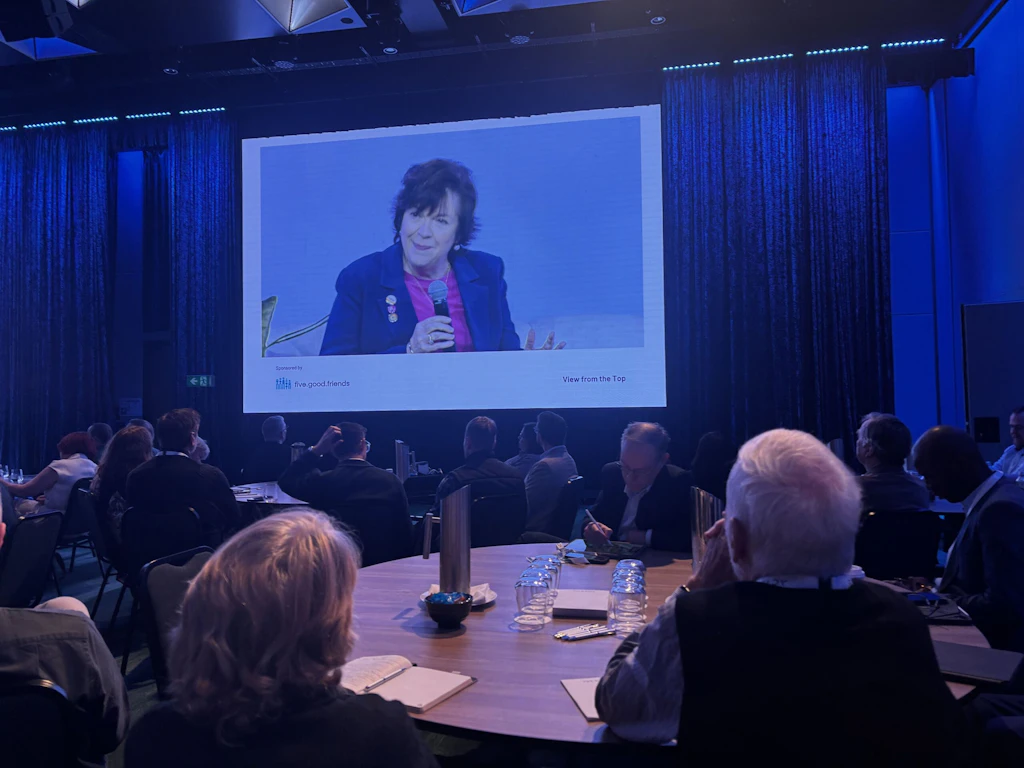
That tension sat at the centre of the View from the Top panel at this year’s National Retirement Living Summit – a session that brought together some of the sector’s most influential operators, financiers and consumer advocates for a frank, unscripted conversation about where retirement living is headed and what’s standing in the way.
Moderated by Retirement Living Council Executive Director Daniel Gannon – session sponsored by Five Good Friends – the panel featured:
- Tony Randello, CEO, Aveo
- Kevin McCoy, CEO, Levande
- Tracey Burton, CEO, Uniting NSW/ACT, and
- Rachel Lane, Principal, Village Guru.
“We’re structurally full and complaining we can’t build”
Tony Randello didn’t mince words. Six years ago when he joined Aveo, the company had 20% vacancy across a significant chunk of its portfolio — roughly $700 million of stock to move. Today, the problem is the inverse: full villages, waiting lists, and a development pipeline that can’t keep pace with demand.
“We’re structurally full in an industry that has happy residents,” he said. “That’s not quite right.”
The blockers are familiar — planning delays, construction costs, and hurdle rates that simply don’t stack up in the current environment. But Randello’s challenge to the room was about mindset, not just mechanics. “We may need to leave some money on the table this cycle and make it up again later. We need to have honest conversations with banks, with capital partners, with investment committees to make that happen.”
Kevin McCoy echoed that optimism-under-pressure. Levande has seven active construction sites and is targeting 200 new units in 2027, scaling to around 300 per year from there. “There’s a housing shortage now,” he said, “and there’ll be an even worse one afterwards. You’ve got to look through all of that and back yourself.”
McCoy also flagged Levande’s management fee construct as a genuine feasibility differentiator — offering a more affordable entry point in challenging market conditions, with the returns building as units turn over time.

The case for insourcing (and AI)
One of the more provocative arguments of the session came from Randello on the question of insourcing. The industry, he argued, has long outsourced to reduce risk — payroll tax, compliance, workforce complexity. But that logic is breaking down.
“Every time we outsource, it costs us and our residents 10% more,” he said, pointing to the input-tax treatment for GST in retirement living. And the risk that operators thought they were offloading? It’s flowing back anyway through modern slavery obligations, data privacy requirements, payroll tax look-through provisions and superannuation.
“All of that risk that we used to outsource is coming back to us. So we should insource, we should integrate, we should adopt AI. What I think is our problem right now will be our biggest opportunity going forward.”
What consumers don’t know is costing them $386,000
Perhaps the session’s most striking number came from Rachel Lane, who has spent years translating the retirement village financial model for ordinary Australians — and is increasingly worried about how little they understand.
“When we’re talking about wait lists, I would question how well informed people are on that waitlist,” she said. “Do they know what type of apartment they want? Do they know how they want to pay for it? Do they understand the impact of choosing those different options?”
The shift Lane is most focused on is the arrival of support at home co-contributions, introduced last November, which have materially changed the calculus between paying via a deferred management fee (DMF) versus paying upfront.
Using a $1 million apartment as an example, she walked through the numbers: paying 20% upfront rather than via DMF at the back end saves approximately $120,000–$150,000 in deferred costs, generates an additional $15,600 per year in pension (or $156,000 over 10 years), and reduces support at home co-contributions by around $8,000 per year. Add it up over a 10-year stay and the difference between the two payment models is approximately $386,000 for a single resident.
“The DMF model was designed to be an affordable housing model,” Lane said. “But forcing people to pay that way isn’t always affordable — sometimes it’s just cheap. And it’s causing them to reduce or lose their pension and pay more towards support at home.”
Her call to operators: give residents a genuine choice. And not just out of altruism — taking $200,000 upfront rather than $300,000–$350,000 in 10 years can, depending on your WACC, be the more profitable outcome too. “It’s not just that you are doing the right thing by your customer. It can also enable you to fund your refurbishments.”
Lane also flagged the Home Equity Access Scheme (HEAS) as an unresolved advocacy opportunity — retirement village residents largely can’t access it, despite its potential to help people fund the care they need without selling up. She urged the Council to take it to the government.
Care: the sector can’t ignore it any longer
Tracey Burton’s contribution brought a different vantage point — as a provider spanning the full continuum, from retirement living through to residential aged care and hospital services, she’s watching the pressure points collide in real time.
“The shortage of aged care beds we’re facing as a country — we will not be able to build our way out,” she said plainly. Residential aged care homes remain “uninvestable on feasibility,” and the numbers bear it out: Australia needs 10,000 new beds a year, and 5,000 people died last year waiting to be assessed for a home care package.
That pressure is landing directly on retirement villages. Tony Randello noted that he’s never had as many conversations about residents who need aged care and simply can’t access it. “It used to happen for a couple of months and then a place would come up. That’s not happening anymore.”
His response: every new Aveo development now includes a co-located residential aged care parcel, and the company is moving hard on flexible service models — replacing the traditional flat general service fee with offerings residents can dial up or dial down, using support at home packages, private pay, or a combination of both. “We will enable them to live independently for longer. That’s the evolution.”
Kevin McCoy pointed to the wellbeing officer model as another piece of the puzzle. Levande funds this role in 50% of its villages and measures the impact: villages with a wellbeing officer score higher on the Australian Unity/Deakin wellbeing index. As AI starts to absorb more of the administrative burden in village operations, McCoy sees an opportunity to redirect that capacity into more human connection.
Burton also cited Uniting’s Geriatric Flying Squad as a proof point for smarter care design — a mobile geriatrician and allied health team that can reach people in their homes or residential care facilities, saving the NSW Government an estimated $7 million in avoided emergency department attendances at a cost of just a few hundred thousand dollars.
One caution on the horizon
Rachel Lane raised a concern that the room would do well to sit with. As retirement village operators develop closer affiliations with residential aged care providers — through co-location, referral pathways and integrated models — there’s a real risk of replicating what’s happened in New Zealand, where residents of affiliated villages get preferential access to aged care, and everyone else misses out.
“We’ve already got a supply-demand crunch,” she said. “And now we’re creating haves and have nots when it comes to who gets aged care.”
It’s a question without a neat answer yet. But it’s exactly the kind of systems-level thinking the sector needs more of.
Tracey Burton’s parting words
This was Burton’s final National Retirement Living Summit as Uniting CEO, and Gannon gave her the final word.
She chose advocacy.
“Being active in the advocacy space, supporting the Council, collaborating with other bodies — particularly consumer representatives and Ageing Australia — to try and get those systems changes to happen. We need to use the voice. Don’t just be receiving of that policy. Try really hard to find what is going to serve senior Australians better.”
A fitting close from one of the sector’s most respected leaders.


